

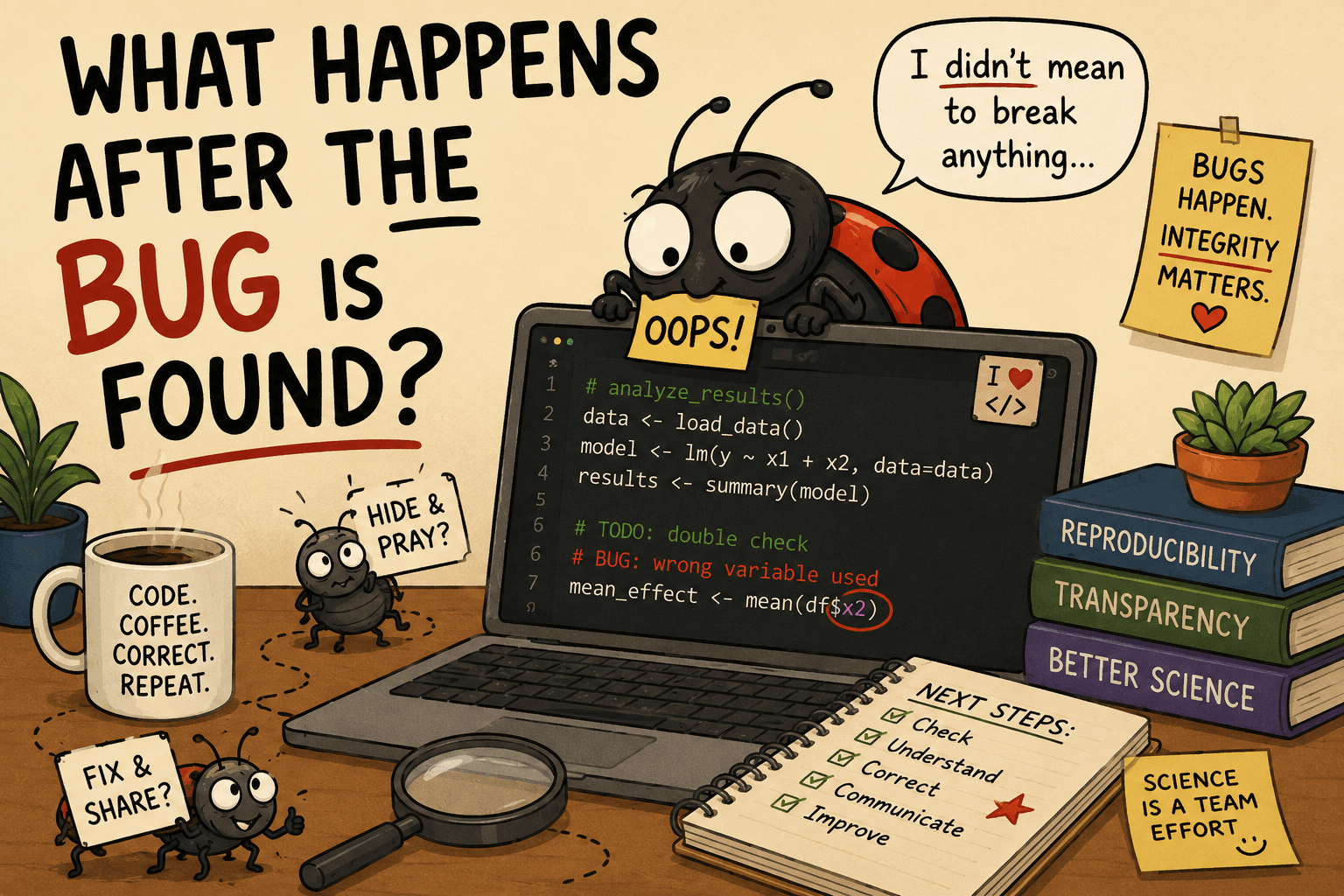
Why is discovering an error often followed by anxiety?
Building on previous I4R blog (Fiala, 2026), “Non-random coding errors,” coding errors are common not only when results do not make sense, but also, perhaps especially, when results make too much sense. If we only check code when findings surprise us, then errors that confirm our expectations may pass unnoticed.
The surprising fact is not that errors exist. The surprising fact is that we still treat them as unusual.
Current academic norms often reward publication, significant results, and clean narratives. Researchers are encouraged to find errors before publication but often discouraged from talking about them afterward. Of course, codes should be checked carefully before publication as published research can shape future academic work, policy decisions, and public debate. But at the end of the day, mistakes happen. When they do, corrections are needed.

Researchers may hesitate to disclose coding errors for many reasons: fear of looking incompetent, fear of criticism, fear of reputational damage, or fear that one mistake will cast doubt on all of their previous work.
But we should pause here. Finding an error and hiding it is not the same as finding an error and disclosing it. These two behaviors should not be evaluated in the same way.
When researchers disclose coding errors, they show that they are actively checking their work. They show transparency. They show that they prioritize accuracy over appearance. Most importantly, they allow the scientific record to improve.

At the same time, not all coding errors are the same. Some mistakes are honest: a typo, a wrong merge, a misunderstood command, or a forgotten line of code. Others may be dishonest: deliberately excluding observations, hiding specifications, or manipulating code to obtain a preferred result.
The distinction matters. But it is also difficult.
Reproducibility can tell us what the code did, whether the results reproduce, and whether a mistake exists. Reproducibility cannot usually tell us what someone was thinking or whether the error was intentional. Intent is often unobservable. As a result, debates about honest versus dishonest errors can quickly become speculative.

This does not mean responsibility disappears. When a paper reaches publication, authors have a responsibility to make sure the analysis is as accurate as possible. But when coding errors are discovered, the appropriate response should be correction, not concealment. Corrections, corrigenda, and even retractions should not be viewed only as punishment mechanisms. They are also mechanisms for maintaining research integrity and credibility. Reproducibility is most valuable when it treats coding errors as opportunities to improve scientific knowledge rather than as evidence of virtue or vice. We often treat “honest mistake” and “dishonest mistake” as the central categories. But in practice, intent is difficult to observe, and sometimes occupy a gray area. What we can observe is how researchers behave when errors come to light.
References
Fiala, L. (2026). Non-random coding errors. Institute for Replication. Retrieved from https://www.i4replication.org/blog/non-random-coding-errors